

Share


The evolution of integrated wealth management and how families can recognize it.
Download "The Changing Landscape for Wealthy Families and Their Advisors" Whitepaper
As wealthy families navigate increasingly complex financial, relational and generational decisions, more advisory firms are expanding their services and describing their approach as integrated wealth management. In practice, however, integration can mean very different things. The number of services a firm offers provides only part of the picture. What matters is how those capabilities come together around the family and the decisions it faces. Drawing on observations from working with multigenerational families, this paper examines the characteristics of a genuinely integrated advisory model and offers practical questions families can use to evaluate whether a firm’s people, processes and economics support the experience it promises.
Key Findings
- As the ultra-high-net-worth community has grown, families have gained more opportunities to learn from one another. Those conversations increasingly extend beyond managing wealth to understanding how wealth affects the family itself.
- Integration depends on how a firm works, not simply on the range of services it offers. Financial, planning, and family-focused disciplines need to connect around a family’s decisions.
- Families evaluating an integrated advisor can look closely at how the firm staffs family learning and communication, brings specialists into the advisory relationship, develops its advisors, works across generations and incorporates family priorities into financial advice.
- An integrated approach can also help families strengthen their own ability to communicate, govern shared wealth and make decisions together over time.
Families that thrive financially and relationally across successive generations are not necessarily those with the best investment performance. Successful families intentionally develop the communication, decision-making, and governance capabilities required to manage shared wealth, and they surround themselves with advisors equipped to support both the financial and human dimensions of family wealth.
The wealth management industry increasingly recognizes this reality. Forward-thinking firms have expanded their services to include family learning, communication, governance and family relationships alongside investment management, estate and tax planning. This broader approach gives families valuable resources. However, some firms expand these services effectively to support the family, while some others use them as a marketing tactic without true commitment to the service. Families can find it hard to distinguish one from the other.
Labels like “family office,” “holistic wealth management” and “integrated advising” are used broadly, without common standards. A firm may offer many services without integrating them or employ specialists without creating structures for those specialists to work together. For families evaluating advisors, the important question is how a firm brings its capabilities together to help families make consequential decisions across multiple generations.
The Changing Environment for Wealth
The ultra-high-net-worth population has grown substantially over the past two decades, as has the number of family offices managing complex wealth. As of 2022, America has 430,000 UHNW households and 74,000 families with $100 million in assets1, and the UHNW market is growing by 9% a year.2 Alongside that growth, a larger community has emerged in which families can learn from one another.
Historically, families were reluctant to discuss wealth’s effect on family relationships. Professional conversations tended to focus on investments, estate structures and business matters, leaving relational and emotional components private. That is changing. Family forums, peer communities, books and podcasts increasingly examine the challenges of multigenerational wealth with a degree of openness that would have been unusual a generation ago.
As a result, the conversation has broadened from how a family manages its wealth to how wealth affects the family that owns it. That distinction has real ramifications for advisors.
A technically sound estate plan can still produce conflict if family members don’t comprehend its purpose. An appropriate investment strategy can become difficult to sustain when family members hold fundamentally different expectations about risk or the role wealth should play in their lives. A well-designed governance structure has little value if family members lack the communication and decision-making skills to use it. Financial decisions and family relationships are rarely as independent as traditional advisory structures suggest.
From Wealth Management to Integrated Wealth Advising
Wealth management firms have expanded their capabilities in different ways. Many still focus primarily on financial capital, while others have added family dynamics, education or governance services to their traditional financial work. The most significant development is an approach that integrates financial and human-capital considerations throughout the advisory relationship.
The Ultra High Net Worth Institute’s Integrated Wealth Management framework illustrates the expanded approach.
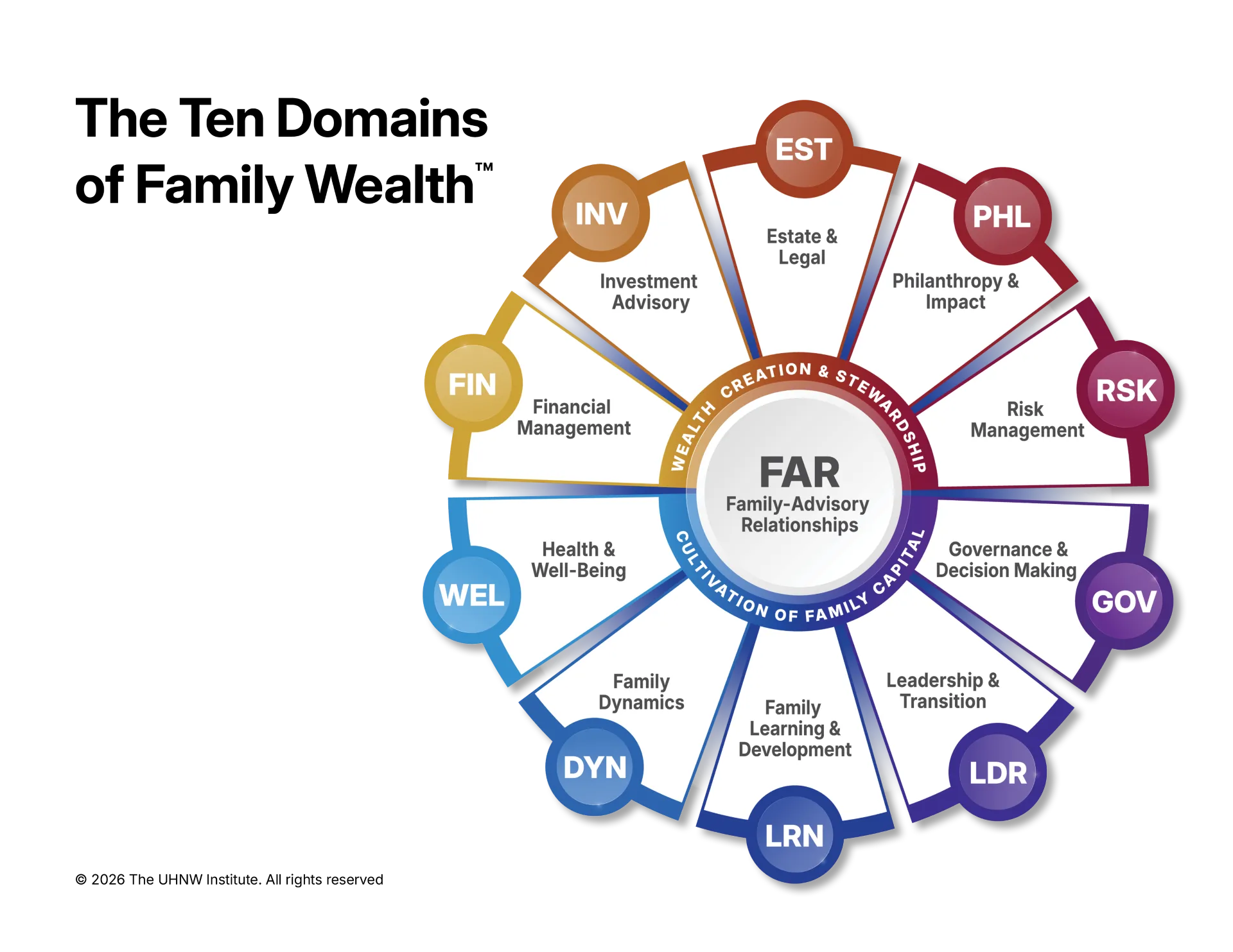
The fact that a family might employ multiple disciplines does not by itself constitute integration. Even with excellent investment managers, estate attorneys, tax advisors and family-learning specialists on a family’s advisory team, they may still receive fragmented advice if those advisors do not communicate. An integrated model creates value by bringing relevant disciplines together when a family faces decisions that cross traditional professional boundaries.
This places a distinct responsibility on the advisor serving as the hub of an integrated team. That advisor must understand the family’s circumstances well enough to recognize when a financial decision affects governance or family relationships, and when family considerations should shape financial decisions.
Case Vignette
A successful business owner from a highly entrepreneurial family initially wondered whether bringing more disciplines into the family’s advisory relationships would help or hinder. For years, he had led family meetings himself, with an administrator handling accounting and a separate firm managing investments. As the family’s needs grew more complex, he also saw that each advisor handled a particular area, but he remained responsible for seeing how the pieces fit together and identifying issues that might otherwise be missed. The experience ultimately changed how he thought about integration: the value wasn’t in having more advisors, but in having someone responsible for connecting them so they could collaborate and make more effective decisions for the family.
How Can a Family Recognize Genuine Integrated Wealth Advising?
Terms like “family office” and “integrated wealth management” lack broadly held definitions. The UHNW Institute has worked to standardize these definitions to help families identify the right services. They define integrated family wealth management as “The most complex model of family office services, covering the full range of financial and nonfinancial services needed by an UHNW family using an integrated approach.”3 Not all financial firms follow this definition when they market integrated wealth management, so families should look beyond service descriptions and examine how a firm actually operates. Several characteristics can help.
1. The firm has sufficient dedicated expertise
Family relations and multigenerational learning require specialized skills. Families should consider both the expertise a firm has and whether its staffing model makes that expertise realistically available.
Questions to ask:
- Who would actually do this work with our family, and what is that person’s background?
- Is he or she part of our regular advisory team or brought in for particular situations?
- How many families does each of these professionals typically work with?
2. Advisors understand both financial and human factors
An integrated advisor needs to recognize where financial decisions intersect with family relationships, priorities and responsibilities. This requires a broad understanding of the family and the judgment to know when a decision calls for specialized expertise.
Questions to ask:
- How do you prepare advisors to work with the financial and family issues that arise in multigenerational families?
- When an issue reaches beyond an advisor’s own expertise, how does he or she recognize that and decide who else needs to be involved?
- When several specialists are involved, who helps the family reconcile their advice?
3. The economics of the firm support the work
Some services associated with integrated wealth advising are time-intensive and require experienced professionals. Family meetings, education and governance work are good examples. A family evaluating these capabilities should understand how the firm pays for and staffs them, particularly when there is no separate fee. The question is less about whether a service is expensive than whether the firm has made a durable commitment to providing it.
Questions to ask:
- How is this work paid for?
- If there is no separate fee, how is it supported within the firm’s business model?
- What should a family expect in terms of access and time from these professionals?
4. Family learning is part of the core advisory model
Many firms offer next-generation education or governance consulting. Families should consider how deeply this work is incorporated into the advisory relationship and whether insights developed through it inform other areas of advice.
Questions to ask:
- Where does family learning fit into the work you do with a family over time?
- Can you give me an example of something learned through a family meeting that affected investment, estate or other financial advice?
5. Family learning involves the whole family and ongoing family meetings
Family learning often involves preparing younger generations for wealth. In practice, each generation may be learning something different. A wealth creator may be figuring out when and how to share decision-making authority. Adult children may be assuming greater responsibility as owners, trustees or participants in family governance. Family members may also learn to make decisions together as their roles change. The work develops along with the family, rather than ending when one generation reaches a particular level of financial knowledge.
Questions to ask:
- Who in the family typically participates in your learning work?
- How would you work with a wealth creator who is preparing to give up some decision-making authority?
- What would you expect adult children or grandchildren to be learning at different stages?
- How do you help a family prepare to make decisions together?
A well-run family meeting can be valuable. It’s even more valuable when it is part of an ongoing process through which a family learns to communicate, establish shared priorities and make decisions together. Families should consider what happens before, during and after meetings and how the outcomes connect to other advisors’ work.
Questions to ask:
- What happens before and after a family meeting?
- If a family makes an important decision in the room, how do you communicate it to the investment, estate or tax professionals who need to act on it?
6. The firm’s processes connect expertise around important decisions
One of the clearest tests of integration is what happens when a family faces a decision that crosses domains. Families can ask prospective advisors to walk through an anonymized example and explain how the firm identified the relevant financial, tax, estate, governance and family considerations, and brought together the appropriate experts and helped the family understand the trade-offs.
Questions to ask:
- Tell us about a family decision that required several different kinds of expertise. How did you recognize which issues needed to be considered and decide who should participate?
- Who kept track of the decision as a whole rather than one piece of it?
- How did you help the family work through recommendations that pointed in different directions?
Case Vignette
One family came to the advisory relationship with plenty of financial sophistication and considerable tension. The mother was in her 70s. Her three adult children had built very different lives: one managed a hedge fund in London, another worked in commercial real estate in Florida and the third worked at a nonprofit in New York.
A facilitated family discussion revealed that they all wanted to protect the family’s wealth for future generations. That discussion led them to limit annual spending to 2% of the portfolio, while each person retained autonomy over their individual allocation.
For the family and their advisory team, that agreement answered questions that portfolio analysis alone could not resolve. The meeting generated a unified strategic purpose for the family which then provided direction to their advisors on spending, asset allocation and time horizons based on a decision the family had reached together.
Looking Beyond the Service List
A list of services is a useful starting point when evaluating a wealth management firm. It says much less about what happens when several areas of expertise need to come together.
Families who work with smaller, independent advisory firms or trusted professionals can also benefit from an integrated approach. They do not need to replace longstanding relationships with attorneys, accountants or investment advisors. Instead, they can seek an advisor who is equipped to coordinate these professionals, recognize when decisions involve both financial and family considerations, and bring in specialized expertise when needed. Family learning can be incorporated into this arrangement through facilitated family meetings, governance discussions and educational programs tailored to the family’s circumstances. The important consideration is whether their advisor has the capacity to be the “expert generalist”4 who takes responsibility for connecting these efforts so that the family receives coordinated advice and develops the skills to make decisions together.
That is where a firm’s approach matters. Who notices that an estate-planning decision also raises a family governance issue? Does the family-learning professional know what the investment team is working on? If specialists offer different recommendations, who helps the family understand the choices and decide? And once the family decides, who makes sure that decision carries through to the other advisors whose work it affects?
These are practical questions about how advice gets delivered. They help a family determine whether specialists who appear together on a firm’s service list also work together around the family. As more firms use similar language to describe integrated wealth management, the answers can reveal meaningful differences in how that integration works in practice.
The Significance for Multigenerational Families
Families today have access to more sophisticated financial capabilities, more specialized expertise and more resources devoted to the human dimensions of wealth than previous generations did. That abundance makes discernment increasingly important.
As “family office,” “holistic” and “integrated” become common descriptions across the industry, families need ways to determine which firms have built the people, processes and structures necessary to deliver genuinely integrated advice.
The distinction matters because multigenerational wealth involves decisions that cannot always be neatly divided among professional disciplines. Questions about what wealth is for, how authority should pass between generations, how family members should make decisions together and how shared wealth can contribute to family cohesion require more than technical expertise.
Families also need the capacity to address these questions. An integrated advisor can support that work by bringing together relevant expertise, clarifying the financial and human dimensions of key decisions and strengthening the family’s ability to make them together.
Bibliography
1. Ensign, Rachel Louise. “They’re Rich but Not Famous—and They’re Suddenly Everywhere.” The Wall Street Journal, March 24, 2026. https://www.wsj.com/economy/wealthy-americansus-economy-dba0d26a?mod=article_inline
2. Gooch, Rebecca. “Defining the Family Office Landscape, 2024.” Deloitte Private, 2024. https://www.deloitte.com/global/en/services/deloitte-private/research/defining-the-family-office-landscape.html
3. The UHNW Institute. “Integrated Family Wealth Management.” Wealthesaurus: A Glossary of Family Wealth Advising Terms, 2024. https://wealthesaurus.org/Wealthesaurus/integratedfamily-wealth-management/
4. McCullough, Tom. “Developing Integrated Advisors Through the Ten Domains of Family Wealth.” The UHNW Institute, Aug. 20, 2026. https://www.uhnwinstitute.org/new-thoughtleadership-developing-integrated-advisors-through-the-ten-domains-of-family-wealth/
5. McCullough, Tom. “The Rise of the Integrated Advisor.” The Journal of Wealth Management, Vol. 26, No. 1, Summer 2023. https://www.uhnwinstitute.org/wp-content/uploads/2023/07/NorthwoodJWM25th2023RiseoftheIntegratedAdvisor-2.pdf