

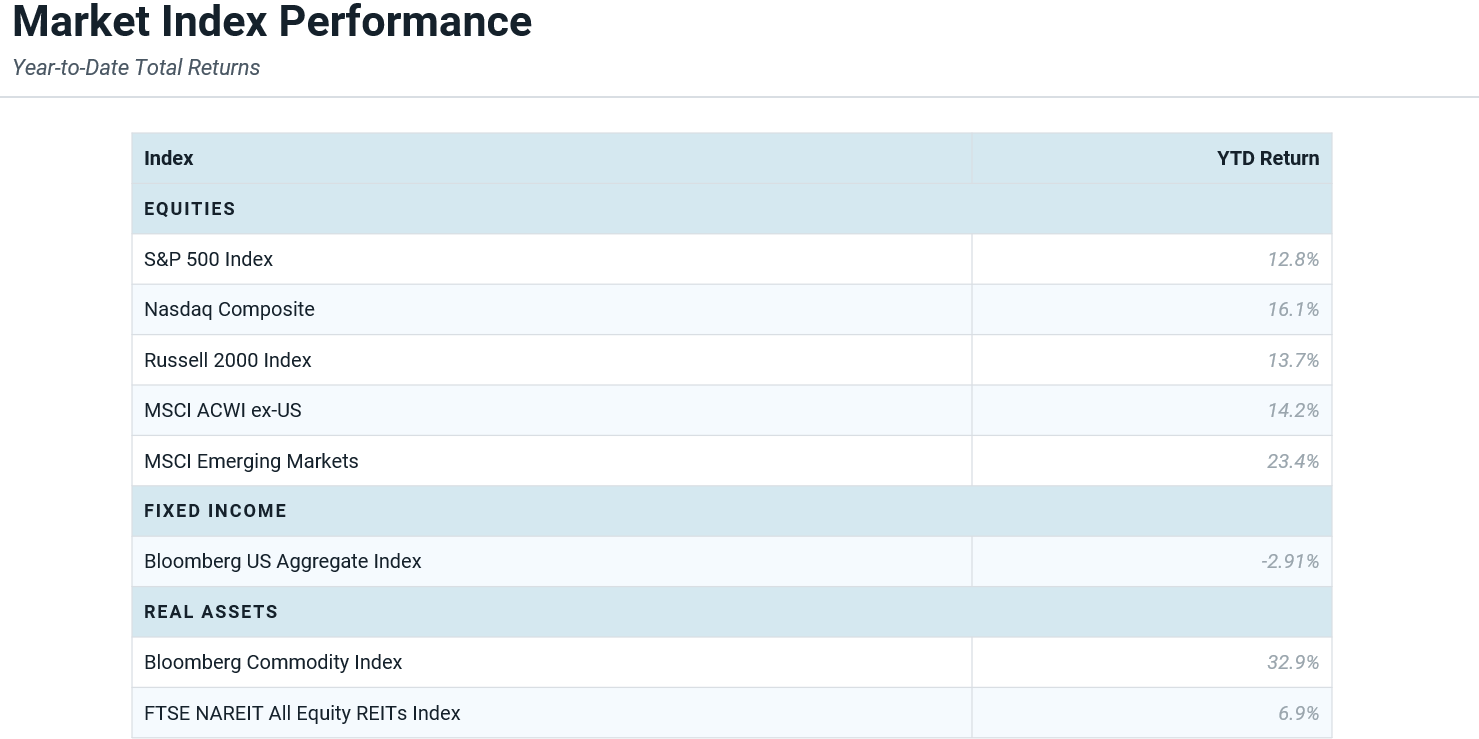
As we turn the page on the third quarter of the year, we are increasingly presented with evidence of an evolving market. Before diving further into what we mean by that, let’s take a quick look to see how markets have performed over the first nine months of the year:
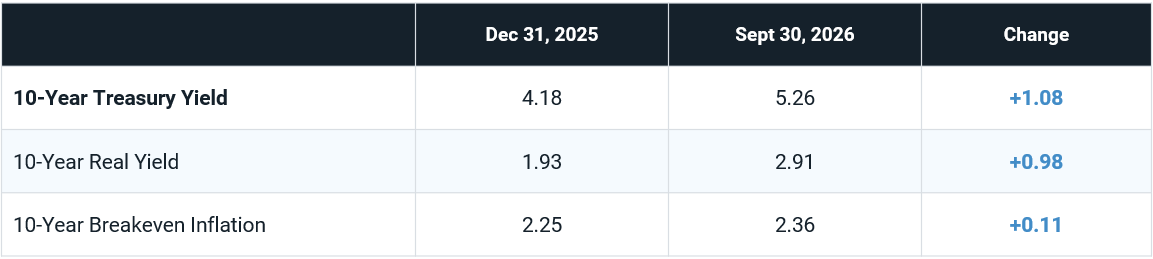
Equities have continued to climb, but something more interesting is happening underneath the index-level return, and it reflects the same question we posed back in our Q2 letter: what are companies actually earning on the extraordinary sums being poured into AI? Meanwhile, the bond market is sending its own signals, namely that the cost of borrowing for the long term has gone up. Inflation itself remains elevated, due in part to higher energy costs tied to conflicts in Europe and the Middle East. But the rise in long-term rates has not primarily been an inflation story. Long-term inflation expectations have crept up only about 11 basis points so far this year. As the table below illustrates, the more meaningful move has been in real yields. In other words, investors want more compensation to lock up capital for longer.
On the surface, these look like two unrelated storylines: an equity market getting choosier, and a bond market repricing. However, we don’t think they’re unrelated at all. We’ve spent the last several quarters chronicling the extraordinary capital flowing toward AI, and the observation we keep coming back to is a simple one: transformative technology doesn’t automatically make every dollar invested in it a good investment. We’ve also spent time on the country’s fiscal picture, which yields an equally simple observation: current debt levels don’t guarantee a crisis, but they shrink our room to maneuver when one shows up.
Put those two threads together, and you get the question worth sitting with this quarter: what happens when extraordinary private-sector capital needs collide with heavy government borrowing at the same time? Economics 101 tells us that prices (in this case, required returns) should go up.
For long-term investors, that cuts two ways. On one hand, this is an opportunity to earn more attractive returns for supplying the same businesses with capital. On the other hand, it’s an obligation to be more disciplined about where we allocate capital because the days of easy money are fading. Both sides of that equation deserve real attention this quarter.
Equities: A More Discerning Market
For most of the last three years, the one-sentence summary of the equity market was: AI, and everything else. Hyperscalers and semiconductor names drove more than half of the S&P 500’s return between 2023 and 2025. This year looks different. Leadership is broadening — hyperscalers are contributing a smaller slice of index returns, while semiconductor, hardware and other AI-adjacent names keep participating.
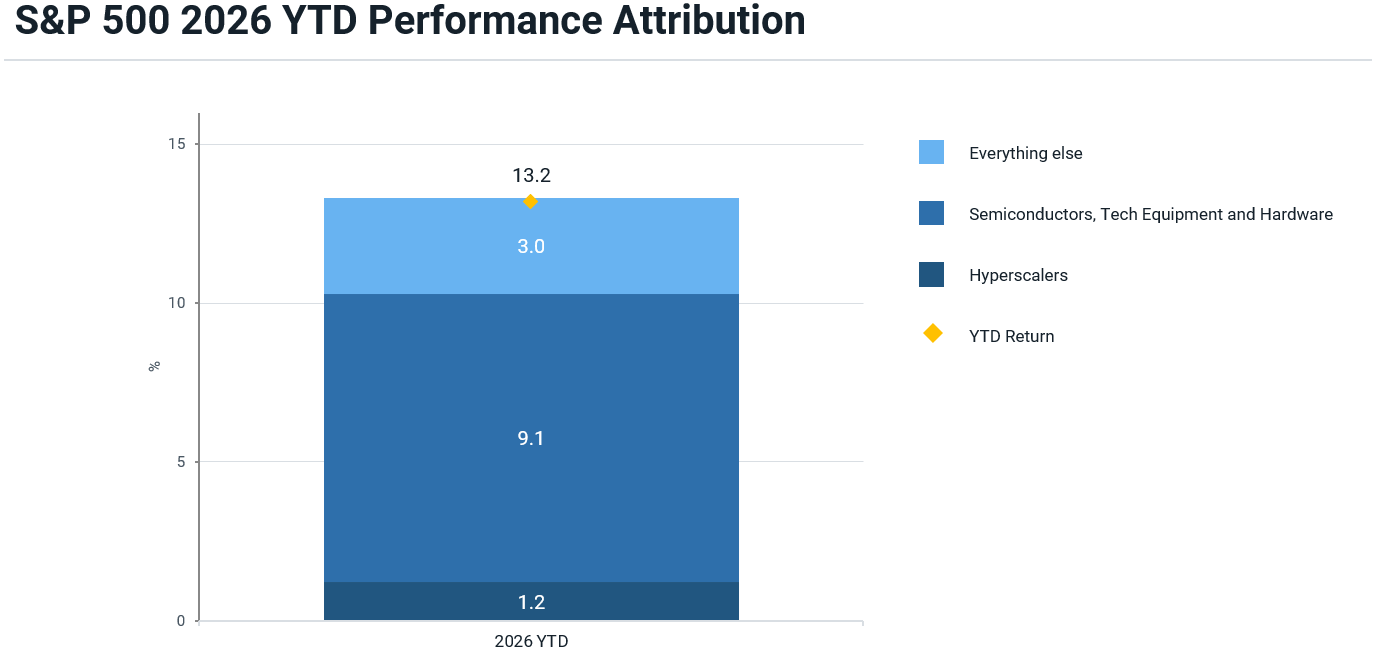
We’re careful not to read too much into a few months of performance. Broader leadership could just as easily reflect interest rates, valuation gaps, stronger growth expectations, or a plain rotation after several years of narrow leadership.
That said, we think the underlying question matters more than the noise around it. In the first phase of this AI cycle, markets rewarded whoever spent the most, the fastest. Increasingly, we think investors are starting to separate the companies that spend capital on AI from the ones that can actually earn a return on it. That’s a healthier dynamic, in our view.
Importantly, we’re seeing the same discernment show up in credit markets. Reuters reported that spreads on AI-linked corporate debt have widened relative to the broader investment-grade market, as investors grapple with the size (and uncertainty) of future financing needs. That distinction matters. The AI debate is no longer just about whether one technology company deserves a rich earnings multiple. Increasingly, it’s about financing an entire physical buildout, and investors throughout the capital structure are being asked to help pay for it.
From a Technology Story to a Capital-Markets Story
The scale of the AI buildout is hard to overstate. Building increasingly powerful models takes a lot more than software engineers and semiconductors. It takes data centers, power generation, transmission capacity, cooling systems, fiber networks, industrial equipment, and no small amount of real estate. Financing all of that is increasingly moving beyond the internally generated cash flow of the largest technology companies. SoftBank, for example, launched an approximately $11 billion bond deal in September to help fund its follow-on investment in OpenAI. More broadly, large technology companies and infrastructure sponsors are leaning on corporate debt, project finance, private credit and other structures to fund data centers and compute power.
In other words: AI started as a technology story. It became a capex story once hyperscalers committed extraordinary amounts of their own cash flow to it. Increasingly, it’s becoming a capital-markets story. That shift creates opportunity—investors can participate in the AI buildout not just through the companies building the models, but through utilities, infrastructure, credit, equipment finance, and the rest of the physical ecosystem underneath them. It also sharpens the question we raised last quarter: more capital doesn’t guarantee more economic value. Every dollar committed today has to generate enough incremental earnings, cash flow, or productivity to justify both the investment and the cost of financing it. And as capital gets more expensive, that hurdle only rises.
The Cost of Competing
There may be another cost increasingly attached to competing at the frontier of AI: regulation. Some of the companies building the most advanced models have themselves called for stronger safety frameworks. OpenAI has pushed for mandatory, capability-based national AI safety regulation, while Anthropic has argued for rules that scale with model capability and risk. It’s tempting to wave off some of the more extreme AI risks because they’re genuinely hard to quantify. But difficult to quantify isn’t the same thing as impossible. The history of technological innovation is full of examples where society developed a capability before fully understanding its consequences—nuclear fission being the obvious one.
We don’t know whether AI ends up mattering far less, or far more, than some of its own developers currently fear. That uncertainty argues for humility, not dismissal. It’s entirely reasonable to believe the companies closest to the technology sincerely see risks worth guarding against. It’s also true that those same companies have an economic interest in how regulation ends up being written. Both things can be true at once. A rule can serve a legitimate public purpose and change competitive economics at the same time. Safety testing, model evaluations, cybersecurity requirements, audits, and compliance systems all cost money—and fixed costs are a lot easier for a company spending tens of billions a year to absorb than for a new entrant.
We’re not suggesting the calls for regulation are insincere, but the investment implication is simpler: regulation itself can become another form of required capital. For investors, the questions worth asking are broader than which model performs best today. For example: how much capital does it take to compete, what actually protects incumbents, and who ends up capturing the value being created?
The Other Large Borrower
The private sector isn’t the only one with an enormous appetite for capital. According to the Budget and Economic Outlook published in February 2026, the Congressional Budget Office projects a federal deficit of roughly $1.9 trillion in fiscal 2026. Debt held by the public is expected to hit about 101% of GDP this year and 120% by 2036. Net interest expense is projected to climb from roughly $1 trillion in 2026 to about $2.1 trillion by 2036. None of that implies an imminent fiscal crisis. The US has advantages a corporate borrower doesn’t: it borrows in its own currency, sits atop the deepest, most liquid Treasury market in the world, and remains the center of the global financial system.
Still, higher debt has a real cost, and that cost is reduced flexibility. As more revenue gets committed to servicing existing obligations, policymakers have less room to respond to the next recession, financial crisis or shock without borrowing even more. Higher borrowing costs reinforce that dynamic. CBO projects the average interest rate on federal debt rising from roughly 3.4% in 2026 toward 3.9% in 2036, as maturing securities get refinanced at today’s rates. The concern isn’t that the US suddenly loses access to financing. It’s that a growing share of future resources goes toward servicing past commitments, leaving less capacity to respond when the unexpected happens. We’ve called this a loss of fiscal resilience before, and we’ll keep calling it that.
What Is the Bond Market Telling Us?
Against that backdrop, the move in long-term yields gets interesting. Since year-end 2025, the rise in the 10-year Treasury yield has come almost entirely from higher real rates—not from higher expected inflation. Ten-year breakeven rates are up only modestly, while real yields have moved substantially.
It’s tempting to pin that move directly on fiscal deficits or AI-related capital needs. We think that’s too simple. Interest rates reflect a lot of forces at once—growth expectations, Fed policy, term premiums, and a variety of other factors. Our point isn’t that public borrowing plus AI investment mechanically equals higher rates. It’s that investors today have more alternatives for their capital, at exactly the moment when several very large borrowers need enormous amounts of it. That combination can move prices, and in our estimation, it is.
Corporate credit reinforces the point. Investment-grade spreads have stayed fairly contained even as Treasury yields rose—which tells us the market isn’t broadly worried about corporate solvency or credit risks. Most of the repricing has happened in the underlying rate for long-duration capital, and increasingly in the specific pockets where financing needs are largest.
Maybe the simplest way to put it: capital has regained a meaningful price.
Portfolio Implications
Here’s how we’re translating all of this into what we’re actually doing across the three major asset classes we spend the most time on.
1. Fixed Income: Better Paid, But We’re Staying Neutral
Real yields have risen enough that high-quality fixed income is doing real work again — investors are being paid meaningfully more to lend than they have for most of the last decade. We recommend maintaining current fixed income allocations rather than adding aggressively, since the same forces pushing yields higher (heavy federal issuance, a wave of AI-related corporate borrowing) also widen the range of outcomes for longer-duration bonds.
Within credit, we favor continuing to build out private credit exposure for families who can tolerate the illiquidity—it offers incremental yield and appropriate lender protections. But we’d emphasize security selection here more than usual. For example, according to Reuters, redemption requests at a large Morgan Stanley private-credit fund stayed elevated in the third quarter, with investors flagging underwriting standards and software borrowers facing AI-driven disruption. We don’t read that as a systemic private-credit problem. We read it as a reminder that when underwriting matters more, manager selection matters more too. Higher yields are the opportunity; security selection is the obligation.
2. Equities: Using Strength to Rebalance, Not Making a Bearish Call
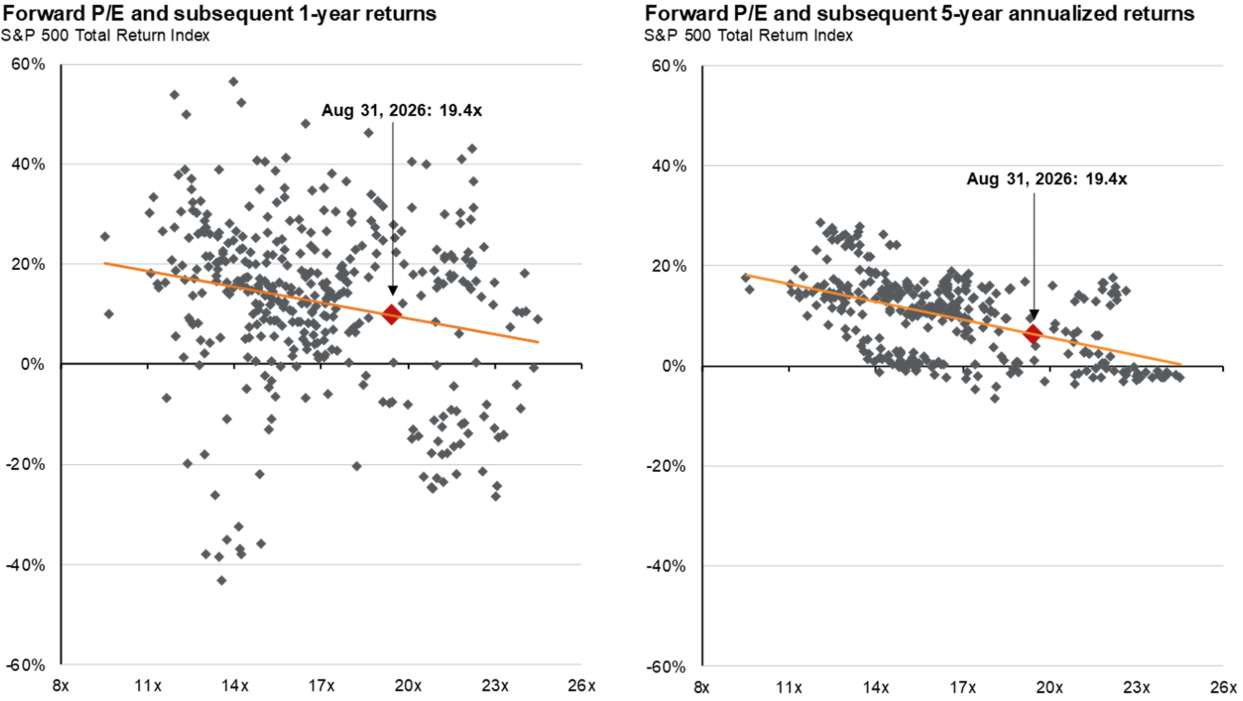
Fundamentals remain fine and earnings growth has kept supporting the market. But valuations are elevated, and a meaningful chunk of the index is concentrated in companies tied directly or indirectly to AI capex. As the chart below illustrates, while current valuations provide minimal insights into short-term (12-month) returns, they do help shape longer-term return expectations. In short, current valuations should temper longer-term investment expectations in public US markets.
We’re not calling for a wholesale reduction in equity exposure—strong earnings growth can support rich valuations for a long time, and fighting the market is perilous. However, we recommend using this strength as an opportunity to rebalance back to target—and accepting the tax consequences that come with it—specifically by trimming positions that have drifted overweight. A common candidate is US Large Cap equities. Said another way, if you have known cash needs over the next 6–12 months, current prices are a reasonable place to fund them from.
We’d also point families toward private equity as a complement here, with one important caveat: we don’t think private equity is attractive simply because it’s private. Manager outcomes vary a lot, and a higher cost of capital makes leverage and multiple expansion weaker sources of return than they were during a multi-decade stretch of falling rates. That’s led us toward middle- and lower-middle-market buyouts specifically—it’s a more fragmented segment with less competing capital. Our research shows historical entry multiples around 7.2x versus 8.6x at the broader-market median, with lower leverage (roughly 3.4x versus 4.74x). Across 2007–2022 vintages, top-quartile small-buyout funds generated a mean IRR of 24.7% versus 20.4% for large buyout funds[1]—though dispersion among smaller funds was meaningfully wider, which is exactly why manager selection carries more weight in this part of the market.
We recommend an intentional increase in private equity exposure toward this segment for families with sufficient liquidity and long enough time horizons—with access, underwriting, and manager selection doing more of the work than the illiquidity premium alone.
3. Real Assets: A Bigger Role, On Purpose
If we’re leaning more on fixed income, we need an answer for what happens if inflation proves stickier than expected—traditional fixed-rate bonds don’t do us many favors in that scenario. That’s where real assets earn their keep.
We’d push back on treating “real assets” as a synonym for “inflation hedge,” though. Owning something tangible doesn’t guarantee protection—financing costs can rise, operating expenses can climb, and an asset bought at the wrong price can still be a bad investment. The better question is whether there’s an identifiable mechanism for inflation to flow into revenues, asset values, or distributions.
Infrastructure fits that description well. Long useful lives, physical scarcity, contractual cash flows, and revenues that reset over time. Transportation equipment is one example we like, evident through our recent investments in ITE Diversified Transportation Asset Fund. Their portfolio is built around long-term leases on railcars, containers, chassis, and aircraft. Historically, lease rates have moved up with inflation and rates while the underlying assets hold meaningful residual value.
We recommend increasing allocations to real assets—particularly infrastructure and transportation strategies with these characteristics—both as an offensive play on long-term demand and constrained supply, and as a defensive complement to inflation sensitivity within fixed income.
Conclusion
There’s a natural tendency in this business to believe that enough research eventually eliminates uncertainty. It doesn’t. We don’t know the ultimate ceiling on AI. We don’t know whether every dollar being invested today earns an adequate return. We don’t know whether long rates stay here, go higher, or eventually come down. And we don’t know whether the current fiscal path ends in higher inflation, higher real rates, gradual currency depreciation, political reform, or some mix of all four.
That’s not a failure of analysis; it’s just the world in which we live. Our responsibility isn’t to call every outcome correctly; it’s to build portfolios that hold up across a range of them, and make sure the return we expect is worth the risk we’re taking to get it. Seen that way, the themes this quarter aren’t as disconnected as they first look. Technology companies need capital to build the next generation of AI. Infrastructure developers need capital to power it. The federal government needs capital to finance its deficits and refinance what it already owes. And we’re the ones supplying that capital.
For most of the last decade, the question was how to find enough return in a world drowning in cheap money. Today, the question has flipped: who needs the capital, what are they using it for, and are we being paid enough to provide it? In fixed income, that means taking the better real yield without pretending duration and credit risk disappeared. In equities, it means respecting the relationship between price and future return while staying diversified across an AI opportunity set that’s still evolving. In private markets, it means demanding a real source of value creation before we accept the illiquidity. And in real assets, it means favoring investments whose economics work on their own — not ones that only make sense as a hedge.
Different asset classes, different risks, same discipline underneath: know what risk you’re taking, and get paid enough to take it.
[1] RCP Advisors: The Case for Small Buyouts